OnlyFans Chargebacks: How Fans Scam Creators After Getting Their Content

How dishonest fans use OnlyFans chargebacks to take back payments after receiving content, what creators report, and how to document disputed sales.
A fan pays for content. The creator delivers it. The fan enjoys what they bought, then disputes the payment and the money disappears from the creator’s earnings. When the buyer knowingly invents a reason to reverse a legitimate purchase, that is a scam, even if it happens through a bank rather than a suspicious payment link.
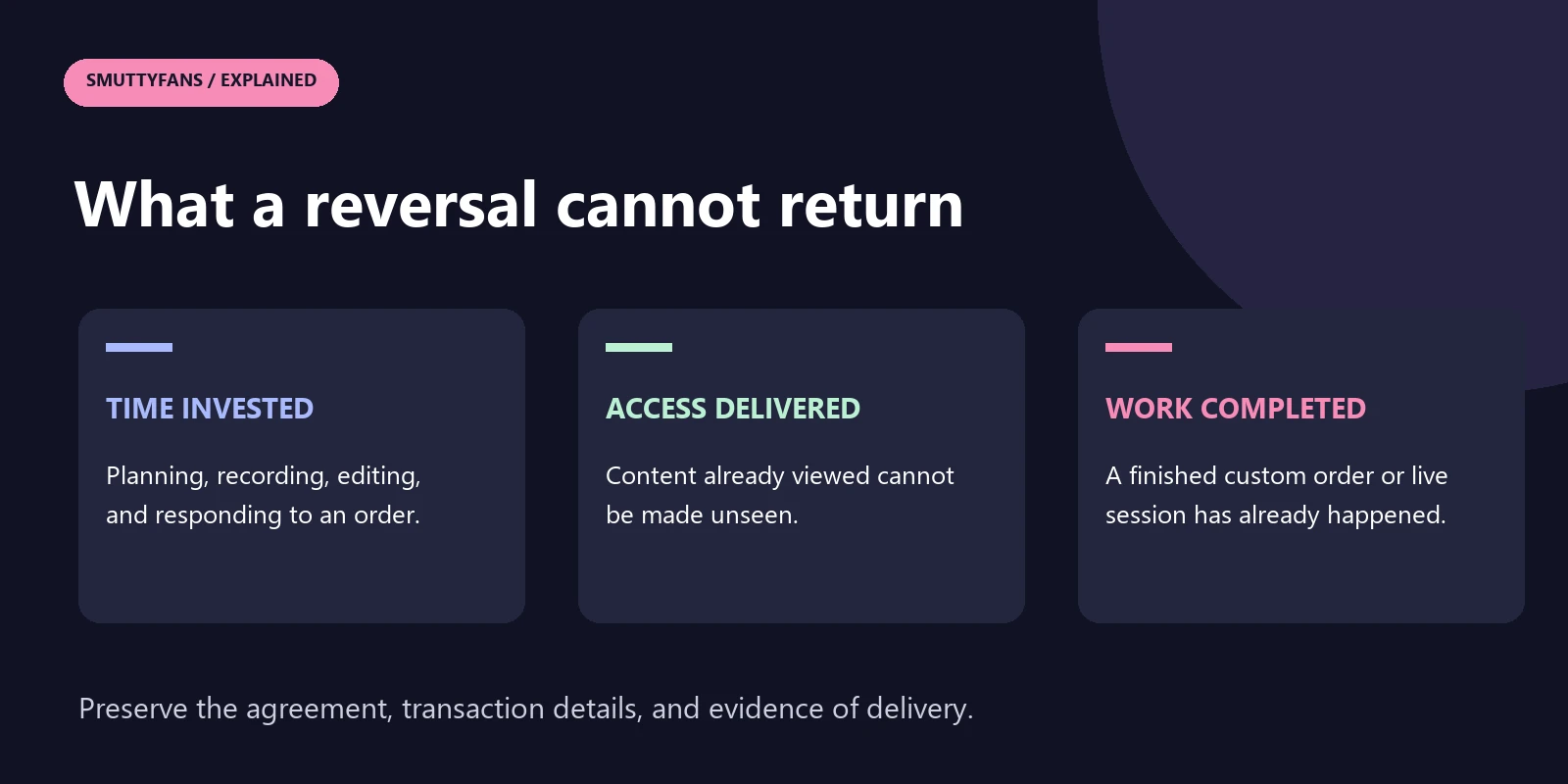
OnlyFans chargebacks can leave creators without payment for work they have already completed. A video cannot be unwatched. A personal conversation cannot be taken back. The hours spent planning, recording, editing, and responding are gone regardless of what happens to the transaction afterward.
Public conversations about OnlyFans scams often focus on disappointed subscribers. Those complaints deserve scrutiny, but creators also describe being on the receiving end of dishonest transactions. Two examples, a statement attributed to Hailey Rose and a discussion on r/onlyfansadvice, show why payment reversals provoke so much anger among people selling digital content.
Their accounts are personal reports, rather than audited evidence of how frequently abuse occurs across the platform. They still raise an important question: when content has been delivered as agreed, why should its creator have to fight to keep the payment?
What Is an OnlyFans Chargeback?
A chargeback is a payment dispute initiated through the buyer’s card issuer. It differs from asking a creator or the platform for a refund. A refund is generally a return of money through the seller’s payment system; a chargeback involves the financial institutions handling the card transaction.
Chargebacks serve a necessary purpose. Someone whose card was stolen needs a way to challenge unauthorized charges. A customer who never received a promised purchase may also have a legitimate complaint. The existence of a dispute does not, by itself, establish that a fan is dishonest.
The abuse happens when someone knowingly misrepresents a valid purchase to recover money after receiving what they ordered. Payment provider Stripe describes this type of chargeback fraud, including disputes over digital products that customers have already accessed. This is a general explanation of card disputes, not a description of OnlyFans’ payment providers.
For a creator, the difference between an ordinary cancellation and a disputed past purchase matters. A subscriber deciding against another month is exercising a choice about future spending. A buyer deliberately reversing payment for an accurately described, delivered order is attempting to avoid paying for completed work.
Hailey Rose’s Statement: A $50 Complaint Beside a Reported $12,000 Loss
In the statement supplied for this article and attributed to Hailey Rose on X, she contrasts a fan’s public complaint about a $50 personalized rating with her own reported chargeback losses. She says the fan received the service, while she has experienced more than $12,000 in chargebacks from people who also received their content.
Her frustration comes through in this line:
“We get robbed all the time and have zero chargeback protection”
The linked post could not be independently retrieved during preparation of this article. The account above therefore reflects the supplied statement; the reported total has not been verified against transaction records. Her broader claim that creators are scammed more often than fans is also her assessment, not an established platform-wide statistic.
Even with those limits, the contrast explains the frustration. A fan can frame a disappointing purchase as a public consumer scandal while a creator’s losses remain hidden inside an earnings dashboard. Readers see the complaint that reaches their feed, rather than a complete history of either person’s transactions.
That does not mean a creator’s past losses excuse misleading advertising or failure to deliver a different customer’s order. Each transaction deserves to be judged on its own facts. It does mean that the familiar story of the powerful creator and the helpless paying fan leaves out the possibility that the creator is the one being exploited.
Our discussion of why OnlyFans creators talk about their earnings looks at how money becomes part of their public image. Chargebacks reveal another side of that image: an impressive sales total does not necessarily describe income that remains available to spend.
The Reddit Discussion: More Than $300 Spent in Two Hours
In the linked r/onlyfansadvice discussion, a creator describes a customer buying more than $300 worth of videos within two hours, then reversing the payments and unsubscribing. The creator says the customer’s account still appeared active and asks whether OnlyFans would take action.
“It’s just so unfair!”
That is the original poster’s account, not independent proof of the buyer’s intentions. Nevertheless, it captures a specific concern: several completed sales can become one concentrated loss, and a creator may see little outward sign of consequences for the account involved.
The reply highlighted alongside the post is deeply critical of support. Its author says creators are not covered, recommends submitting screenshots showing the conversation and delivery, and describes feeling that the platform accepts little responsibility despite taking a commission. The commenter also alleges that an unrelated overpayment by the platform was later reclaimed.
That last allegation concerns a separate accounting issue and does not prove anything about how a particular card dispute was handled. Its relevance is emotional: the commenter feels that financial responsibility repeatedly lands on the creator.
The thread contains disagreement, too. Other participants claim that some disputed payments were recovered after evidence was submitted, while the original poster later reports that support declined reimbursement. These are mixed personal experiences, not a reliable promise of recovery or proof that every appeal fails. The useful lesson is to document and report a disputed sale without assuming a particular outcome.
How Dishonest Chargebacks Harm Creators
The central abuse is straightforward: a customer receives the agreed digital product or service, then knowingly contests the payment on a false basis. There is no need to speculate about an individual buyer’s private motives to recognize the harm this can cause.
Unlike a returned physical item, delivered digital content cannot simply be put back into stock and removed from the customer’s memory. Revoking future access also cannot undo access that already happened. If a buyer retained an unauthorized copy, a payment reversal does not make that copy disappear.
A custom order can make the imbalance worse. A creator may spend time discussing requirements, preparing a setting, filming, editing, and delivering something tailored to one customer. Some of that work may have little value for anyone else. The payment is compensation for that labor as well as access to the finished file.
Live services create a similar problem. Once a scheduled session has taken place, the creator cannot recover that appointment and sell the same hour again. Clear expectations matter for OnlyFans video calls, where time, availability, and agreed boundaries are part of what the customer purchases.
The damage can extend beyond the original amount. Answering support requests, finding screenshots, reconstructing conversations, and tracking a dispute all take time. Even when a creator eventually recovers the payment, dealing with the case can interrupt other paid work.
Why a Reversed Payment Can Hurt More Than the Sales Figure Suggests
Imagine a creator accepts a $300 custom order and spends an afternoon completing it. This is an illustrative example, not a reconstruction of the Reddit transaction. If the earnings associated with that sale are later removed, the creator still has the same production costs and has already given up the afternoon.
Those costs might include equipment, editing software, props, internet access, or help with production. Some are ongoing business expenses rather than expenses caused by one sale, but the sale was supposed to contribute toward covering them. A reversal removes that contribution without reversing the work.
The timing also matters. A creator may have planned around an earnings balance that subsequently changes. An unexpected deduction can disrupt a budget even when the original transaction was relatively small. Repeated losses make it harder to judge which income can safely support future commitments.
This is why screenshots of gross sales are an incomplete picture of a creator’s business. Revenue, platform deductions, operating expenses, disputed transactions, and retained earnings answer different questions. A strong month of sales can coexist with uncertainty over how much of that money the creator will ultimately keep.
There is also a trust cost. Someone who has delivered several orders only to lose the payments may become more cautious with the next enthusiastic buyer. That caution can affect honest fans, who encounter slower booking decisions or firmer limits because another customer previously abused the relationship.
Does OnlyFans Protect Creators From Chargebacks?
The sources discussed here do not support a promise that every completed sale is protected. Hailey Rose’s supplied statement describes feeling unprotected, and the Reddit discussion contains reports of deductions that creators say they could not recover. It also contains claims of successful recoveries in some cases.
OnlyFans’ current terms could not be retrieved during preparation of this article, so this article does not quote a current chargeback clause or claim to establish every circumstance in which the platform will reimburse a creator. Creators should check the terms available through their own account and seek a written explanation from support about their particular transaction.
There is also a distinction between the platform’s treatment of creator earnings and the banking process behind a card dispute. As Stripe explains in its general guide to fraudulent transactions, evidence can be submitted to contest a dispute, but the card issuer decides its outcome. That guide does not establish OnlyFans’ internal procedures.
Neither a creator’s frustration nor a support response tells an outside reader everything the platform submitted, what the bank considered, or whether account restrictions were applied privately. A visible profile alone cannot prove that an account faced no consequences. Creators still have good reason to ask for clearer explanations of what happened to their earnings and what review is available.
A Chargeback Is Not Automatically a Scam
Protecting creators requires making a clear distinction between abuse and legitimate complaints. Unauthorized card use, missing purchases, duplicate billing, and materially misleading descriptions should not be dismissed merely because the seller makes adult content.
Likewise, an accurate description and a delivery record do not settle every question. The person using an account might not have been authorized to use the card. A file might have been sent but not matched what was promised. A fair review needs to consider the actual dispute rather than assume that either party must be lying.
What deserves criticism is deliberate dishonesty: a buyer knowingly receiving the agreed purchase and then inventing a reason to reclaim the payment. Regretting a voluntary purchase is different from proving it was unauthorized or not supplied as agreed.
The emotional context can make these arguments especially heated. Our article on the psychology of paying for sex online explores how desire, expectations, and spending interact. Those feelings can help explain a conflict, but they do not change the facts of what was agreed and delivered.
What Creators Can Do Before a Dispute
Creators cannot control a card issuer’s decision, but they can make their own records clearer. The aim is to reduce misunderstandings and preserve evidence of a legitimate sale, rather than promise that any routine will make chargebacks impossible.
Put the Agreement in Writing
For a custom order, confirm the price, deliverable, approximate length or scope, delivery window, and any important exclusions before accepting the work. If a request crosses a boundary, say so before payment. Keep the agreement within the platform’s permitted communication and transaction systems.
A clear description helps honest customers understand what they are buying. It also gives support something concrete to compare with the delivered order. Broad promotional language is less useful in a dispute than a specific agreement about what the price includes.
For subscriptions, explain what the subscription unlocks and which purchases cost extra. The distinction discussed in our guide to no-PPV OnlyFans accounts matters here: customers should understand whether they are buying feed access, a separate paid message, or an individual service.
Keep Relevant Records Securely
Preserve the transaction reference, date, amount, agreed description, delivery message, and relevant customer responses. Where the platform makes access or unlock information available, retain the relevant record. Do not claim to possess technical information that the platform does not actually show you.
Store those records securely and limit them to what is needed. Conversations can contain intimate personal information about both parties. Evidence belongs in an appropriate support process, rather than in a public post exposing a customer’s identity or private messages.
Set Workload Boundaries
A large purchase is not proof of fraud, and a new account is not automatically suspicious. Still, creators can set consistent limits on how much custom work they accept at once, especially when several requests arrive before an earlier order is finished.
These limits are a way to manage exposure and production capacity. They should not become accusations against every enthusiastic subscriber. A reasonable booking policy also helps creators avoid accepting more work than they can deliver within the promised time.
What to Do After an OnlyFans Chargeback
Start by checking the transaction details. An earnings adjustment might reflect a refund, a disputed payment, or another issue. Record exactly what the dashboard says and ask support to clarify anything ambiguous before building a case around an assumption.
Next, assemble a short timeline: when the order was agreed, when payment occurred, what was promised, when delivery happened, and any relevant acknowledgment afterward. Attach the matching records and identify the affected transaction clearly. A concise account is easier to assess than a long message that mixes several unrelated complaints.
Ask support what review is available, whether any additional evidence is needed, and whether there is a submission deadline. Keep the ticket number and subsequent replies. Avoid treating a generic dispute timeline from another payment provider as an OnlyFans deadline.
If the case remains unresolved, a follow-up can ask for a written explanation of the deduction and the evidence considered. Preserve the response even if it is disappointing; it helps keep the record complete and avoids reconstructing the same case repeatedly.
Do not promise that screenshots will win the case. Do not assume that a payout, a waiting period, or a watermark guarantees protection from a later dispute. A watermark can help identify content, but it cannot force a bank to uphold a payment. Clear records improve the quality of the case; they do not control its outcome.
Why Chargebacks Damage Relationships With Honest Fans
Many creators sell an experience built around attention, familiarity, and ongoing conversation. That makes a disputed payment feel personal, especially when it comes from someone who previously seemed supportive. The financial loss arrives alongside a sense of betrayal.
Our article on OnlyFans parasocial relationships examines how paid interactions can become emotionally significant. Those feelings can affect creators too. Being friendly and attentive does not make a sale less commercial or turn completed work into something a customer can simply take back.
The broader consequence is a less welcoming experience. A creator who fears another loss may decline complicated requests, limit availability, or spend more time documenting conversations. Honest fans then encounter policies shaped partly by other people’s abuse.
Fans who want a healthier relationship with creators can help by reading descriptions, asking questions before purchasing, and raising genuine problems accurately. Supporting a creator includes respecting the price of work that was delivered as agreed. It also includes accepting that boundaries and booking limits may be necessary for someone running a small business.
What Better Creator Protection Should Look Like
Creators deserve an understandable explanation when earnings are removed. That includes identifying the affected sale, explaining the type of adjustment, outlining any review process, and stating what evidence can be submitted. An unexplained deduction leaves people guessing about both their income and their next steps.
A meaningful protection policy would also clearly define what it covers, what it excludes, and who bears a loss when delivery is documented. It should distinguish dishonest disputes from genuine unauthorized payments and genuine failures to supply an order. Fairness requires a process that can recognize either party’s evidence.
The reports discussed here do not establish how common chargeback scams are, and they do not justify assuming every complaining fan is a fraudster. They do show why creators want more than reassurance that a complaint has been received.
When someone knowingly buys content, receives the agreed purchase, and lies to reverse the payment, the creator has done the work and lost the compensation. Digital access may be easy to deliver, but creating it still costs time, money, and effort. Those costs deserve the same respect as the labor behind any other completed sale.